
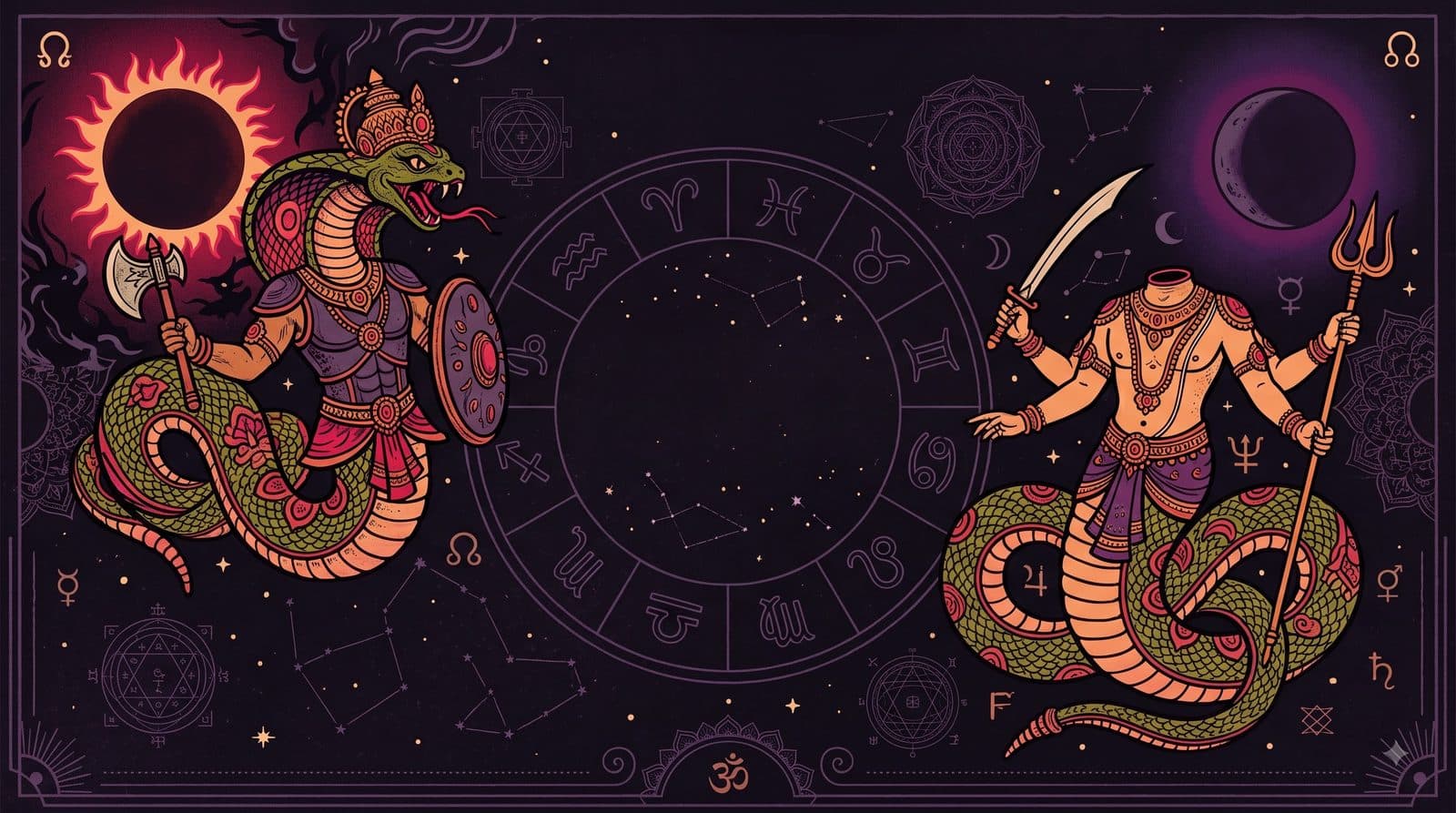
Rahu Ketu Calculator
Rahu and Ketu are the lunar nodes — shadow points, not physical planets — always placed exactly opposite each other in your chart. Together they mark the axis Vedic astrology uses to read karmic patterns, ambition, and detachment.
Since they're defined by the Moon's orbit rather than a visible body, their sign changes slowly — roughly every year and a half — but which house they land in depends on your own Lagna.
100% free
No payment or signup needed for this calculation.
Real Vedic calculations
Computed with an actual astronomical engine, not a guess.
Instant results
Calculated live, right on this page, in seconds.
Your details stay private
Used only for this calculation — never sold or shared.
What are Rahu and Ketu?
Rahu (the North Node) and Ketu (the South Node) are the two points where the Moon's orbit crosses the plane of the Sun's apparent path — not physical bodies, but mathematically real points that Vedic astrology treats as full planetary influences in their own right.
Because they mark opposite ends of the same orbital axis, Rahu and Ketu are always exactly 180° apart — whatever sign and house Rahu occupies, Ketu occupies the sign and house directly opposite it.
How your Rahu Ketu placements are calculated
The calculation finds the Moon's orbital node positions at your exact birth date and time (using the same sidereal, Lahiri-ayanamsa system as the rest of your chart), then places Rahu and Ketu into their signs and — combined with your Lagna — their houses.
The nodes move slowly and retrograde, taking about 18 months to cross a single zodiac sign, so your birth date matters more here than your exact birth time — though birth time and place still decide which house each one falls in.
Why Rahu and Ketu matter
Rahu is traditionally associated with worldly ambition, obsession, and sudden, unconventional gains, while Ketu is linked to detachment, spirituality, and unfinished patterns carried from the past. Where they fall in your chart shapes what a reading calls out as your biggest drives and blind spots.
Their placement is also central to identifying doshas such as Kaal Sarp Dosh, and to the Vimshottari Dasha system used to time significant periods of change in a life.